
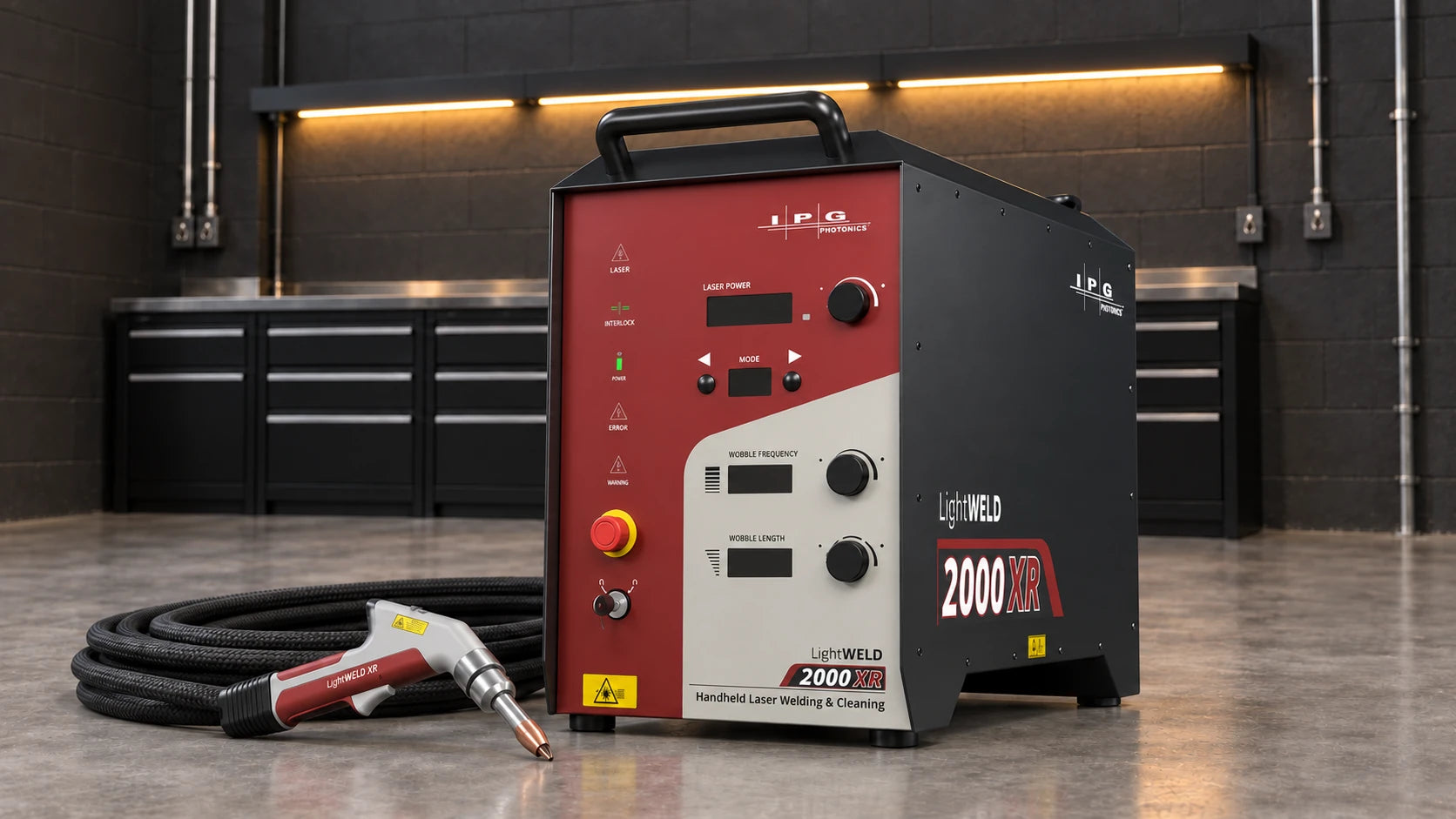
Looking for a laser welder for sale in Australia? Fibre laser welding is becoming a practical choice for fabrication shops, repair businesses and production workshops that want fast, clean welds with less distortion and finishing work.
This guide explains how to compare handheld fibre laser welders. The IRONWELD names below are supplier-listed examples; obtain the model manual and a trial on your actual joint before ordering.
What is laser welding?
Laser welding uses a concentrated fibre laser beam to put heat precisely where it is needed. Compared with conventional arc welding, the smaller heat-affected zone can help reduce distortion, spatter and post-weld grinding when the machine is correctly set up and operated.
Many modern handheld fibre laser welders are also multifunction machines. Depending on the model and fitted accessories, they can weld, cut and clean, giving a workshop more flexibility from one platform.
Why choose a handheld fibre laser welder?
- Production speed: Compare completed, inspected joints on your own material, including setup and finishing time.
- Lower heat input: Focused energy helps minimise distortion, especially on thin sheet and visible-finish work.
- Less post-weld cleanup: Low-spatter welds can reduce grinding and cleaning before coating or assembly.
- Additional functions: Cutting or cleaning requires the manufacturer's approved configuration and operating procedure.
- Operator control: Check the gun's weight, controls, cable reach and support during a demonstration.
How much power do you need?
Laser power is one of the most important buying decisions. The right choice depends on the materials you weld, the thickness you handle most often, your duty cycle and whether the machine will be used for occasional repairs or continuous production.
| Laser welder | Best suited to | Key point |
|---|---|---|
| IRONWELD 1500W IW-15PRO | Trial on the intended material, thickness and joint | Supplier listing states 1500 W and a 15 A single-phase plug; confirm the circuit and approved functions in the model documentation |
| IRONWELD 2000W IW-20PRO | Compare against the 1500 W option using the same joint and acceptance criteria | Confirm cooling capacity and sustained operating limits with the supplier |
| IRONWELD 3000W IW-30PRO | Assess only against a defined production requirement | Laser power alone does not establish weldable thickness or productivity |
| IRONWELD 3000W IW-30DPRO Double Feeder | Confirm what the double-feeder configuration actually does | Do not assume it means automatic wire selection or simultaneous feeding without the model instructions |
A manufacturer manual was not available in the reviewed material for these IRONWELD examples. Treat the names and advertised power as supplier information, not independently verified process capacity. Request written specifications and application trials.
What to check before buying a laser welder
1. Material and thickness
Confirm the machine is suitable for the metals you work with, such as mild steel, stainless steel and aluminium. Check the manufacturer’s thickness guidance for your exact application and remember that joint fit-up, travel speed, wire choice and shielding gas all affect results.
2. Cooling system
Check the cooler's rated capacity, coolant specification, maintenance and ambient operating limits. Water cooling does not make a machine dustproof; the enclosure and air intakes still need the protection and cleaning specified by the manufacturer.
3. Power supply and workshop requirements
Have the actual supply requirements checked against the site circuit before purchase. A plug rating alone does not establish that an existing outlet and circuit are suitable for the intended workload.
4. Wire feeding and operator ergonomics
Consistent wire feeding matters for repeatable welds. Look for a dependable feeder, practical cable protection, a comfortable gun and controls that can be adjusted without constantly leaving the workpiece.
5. Support, training and consumables
A laser welder is a production system, not just a power source. Before buying, ask about training, warranty, replacement parts, lenses, nozzles, liners, protective equipment and ongoing technical support.
Laser welding safety
Arrange a Class 4 laser safety assessment before installation. Confirm laser-rated containment, interlocks, eye-and-face protection, extraction, training and approved operating procedures for every intended function.
Frequently asked questions
Is laser welding better than MIG welding?
Neither process is best for every job. Laser welding can be faster and cleaner on suitable materials and thicknesses, while MIG remains a flexible and familiar choice for many general fabrication tasks. The best process depends on your work, finish requirements and production volume.
Can a laser welder also cut and clean?
Some 3-in-1 fibre laser systems are designed for welding, cutting and cleaning. Check the individual product specification, accessories and approved operating procedures before using those functions.
Which laser welder should I buy first?
Start with a demonstration on representative parts and an agreed weld acceptance test. Compare weld quality, cycle time, fit-up tolerance, cooling and installation cost; a 1500 W, 2000 W or 3000 W label alone cannot choose the right machine.
Find the right laser welder from A&S Welding Supplies
Explore the current IRONWELD laser welder range or contact our Smithfield team for advice on machine power, material thickness, setup and accessories. We can help you choose a laser welding solution that fits your workshop and the work you actually do.
Related guides
Safety guideLaser Welding Safety: Workshop Setup, PPE and Fume Control Buying adviceWelding Duty Cycle Explained: Choosing the Right Welder Machine guideUNIMIG ENVY OMNI 220 AC/DC: Features and Workshop UsesCompare a complete laser welding setup.
Tell us about the parts you make, your workshop and your support requirements.
Ask us about thisTechnical sources and scope
Reviewed 22 September 2026. Manufacturer examples apply to the named equipment; use the current manual for your exact model and the required welding procedure.
- IPG LightWELD — laser welding safety basics
- A&S — IW-15PRO supplier listing (manufacturer manual not obtained)
Manufacturer manuals were not obtained for the IRONWELD examples. Supplier-listed names are retained, but unverified performance, supply and feeder assumptions are not presented as established capabilities.


