
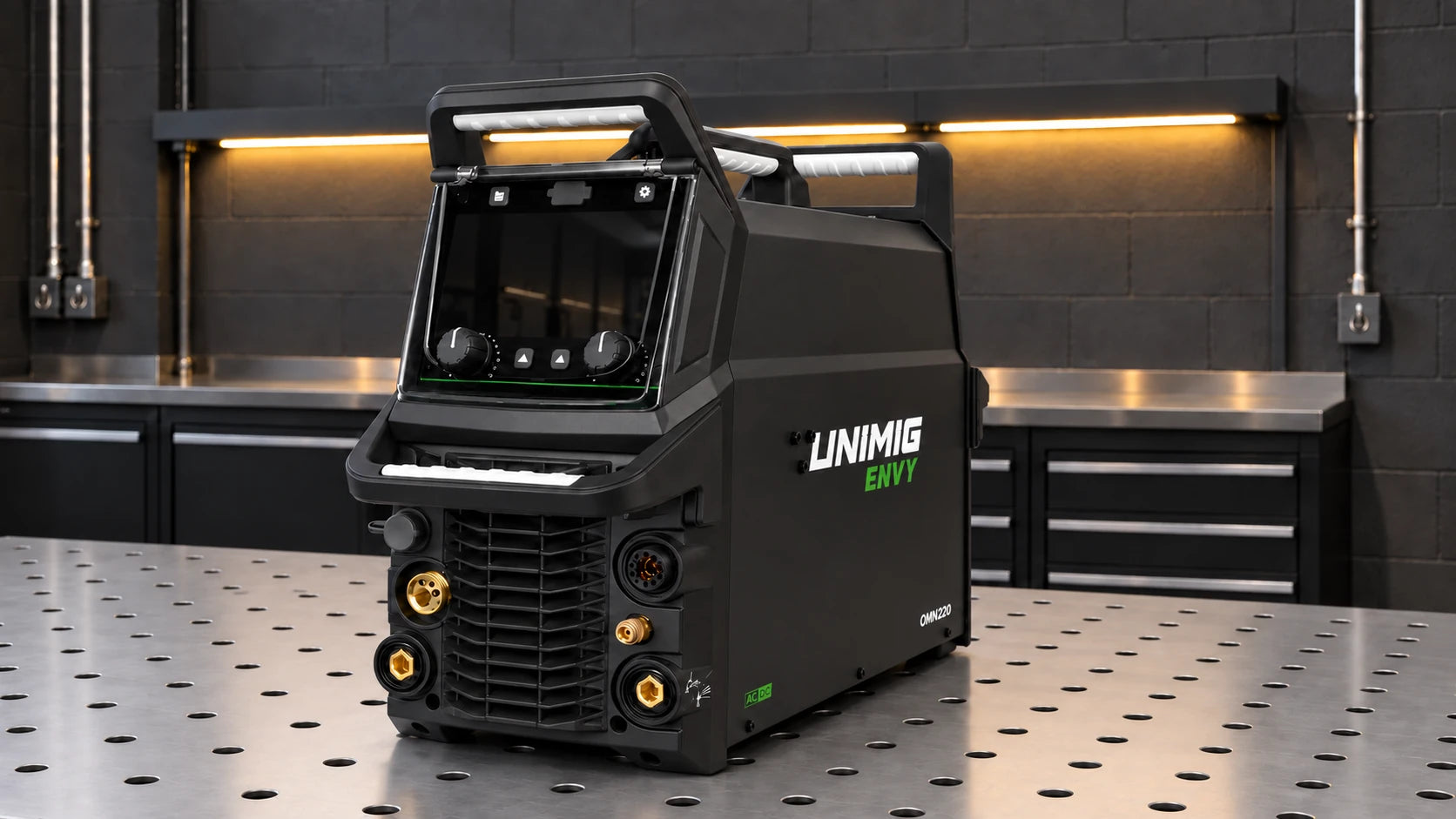
The UNIMIG ENVY OMNI 220 AC/DC combines several welding processes and plasma cutting in one power source.
The practical buying question is whether those processes, their output limits and the required accessories suit your work.
This overview describes the manufacturer's published features. It is not a record of an independent workshop test.
Use it to build a shortlist and identify what to check in a demonstration.
Which processes are included?
The published process list includes:
- MIG welding
- Single pulse MIG
- Double pulse MIG
- AC/DC TIG
- MMA / stick welding
- Plasma cutting
That combination can suit a workshop that changes processes between jobs. Check the gas, torch and consumable changes each mode requires.
Workshop space and changeovers
One power source may reduce equipment footprint, but the complete setup still includes accessories and services for each process.
Not everyone wants three or four separate machines taking up room in the workshop. Not everyone wants to buy a dedicated MIG, a dedicated AC/DC TIG, and a separate plasma cutter just to cover the jobs that come through the door.
Compare the complete package with separate machines, including maintenance and the effect of one unit being unavailable.
For mobile work, check transport weight, power supply and the equipment needed at the job.
MIG and pulse modes
The OMNI lists both single-pulse and double-pulse MIG.
Check which material, wire and gas combinations are supported by its programmes.
Compare the result on your actual joint; a pulse setting does not guarantee lower heat input, less spatter or adequate fusion in every application.
Confirm aluminium wire-feeding requirements and the included torch arrangement before purchase.
AC/DC TIG capability
Check TIG output type separately from the machine's other processes.
With the ENVY OMNI, you are not limited to a basic lift TIG setup. You are getting AC/DC high-frequency TIG, which is what actually makes it useful for proper aluminium TIG work.
AC TIG is commonly used for aluminium; DC TIG is commonly used for steel and stainless steel. Other alloys need a material-specific procedure and suitable shielding.
An available output mode does not establish a procedure for every alloy.
Confirm the TIG torch, remote control and other accessories included in the quoted package.
Plasma cutting capability
Compare the advertised cut rating with the material you actually cut.
Cut quality, travel speed and the supplied air all matter.
UNIMIG advertises 20 mm clean cutting and 25 mm severance on mild steel. These are different quality levels, not interchangeable production ratings.
Check the required compressed-air supply and consumables, then trial the required edge finish.
Controls and wire feeding
Published features include:
- Smart-Set for faster setup
- Automatic polarity switching
- Line resistance detection
- Digital 4-geared wire feed system
- D200 and D300 spool support
- Smart fan control
Check how these functions operate in the current model manual.
Automatic setup still needs the correct wire, gas, process selection and a trial weld.
Who should compare this machine?
Start with your required processes and normal workload.
It may be worth comparing for:
- fabricators who need one versatile workshop machine
- customers moving into aluminium work
- repair and maintenance jobs where process flexibility matters
- buyers who want AC/DC TIG without giving up MIG and plasma
- workshops comparing one shared power source with several dedicated machines
Check the duty cycle in every mode you plan to use.
What to confirm before buying
Request a demonstration using your material and joint.
Include installation, accessories, training and servicing in the comparison.
It is not the right machine for every single person. If someone only ever does one process all day every day, a dedicated machine may still make more sense.
Choose it only if the demonstrated result and operating limits meet the work you need to do.
Ask A&S Welding Supplies for the current manual and package details.
Related guides
Buying adviceBest Beginner Welder Australia 2026: MIG, TIG or Multi-Process? Buying adviceWelding Duty Cycle Explained: Choosing the Right Welder Buying adviceLaser Welders in Australia: How to Choose a Fibre Laser WelderCheck the OMNI against your actual jobs.
Send us your materials, thicknesses and the processes you want to use.
Ask us about thisTechnical sources and scope
Reviewed 22 September 2026. Manufacturer examples apply to the named equipment; use the current manual for your exact model and the required welding procedure.
Published features are distinguished from testing. No independent A&S performance test was supplied or claimed.


