
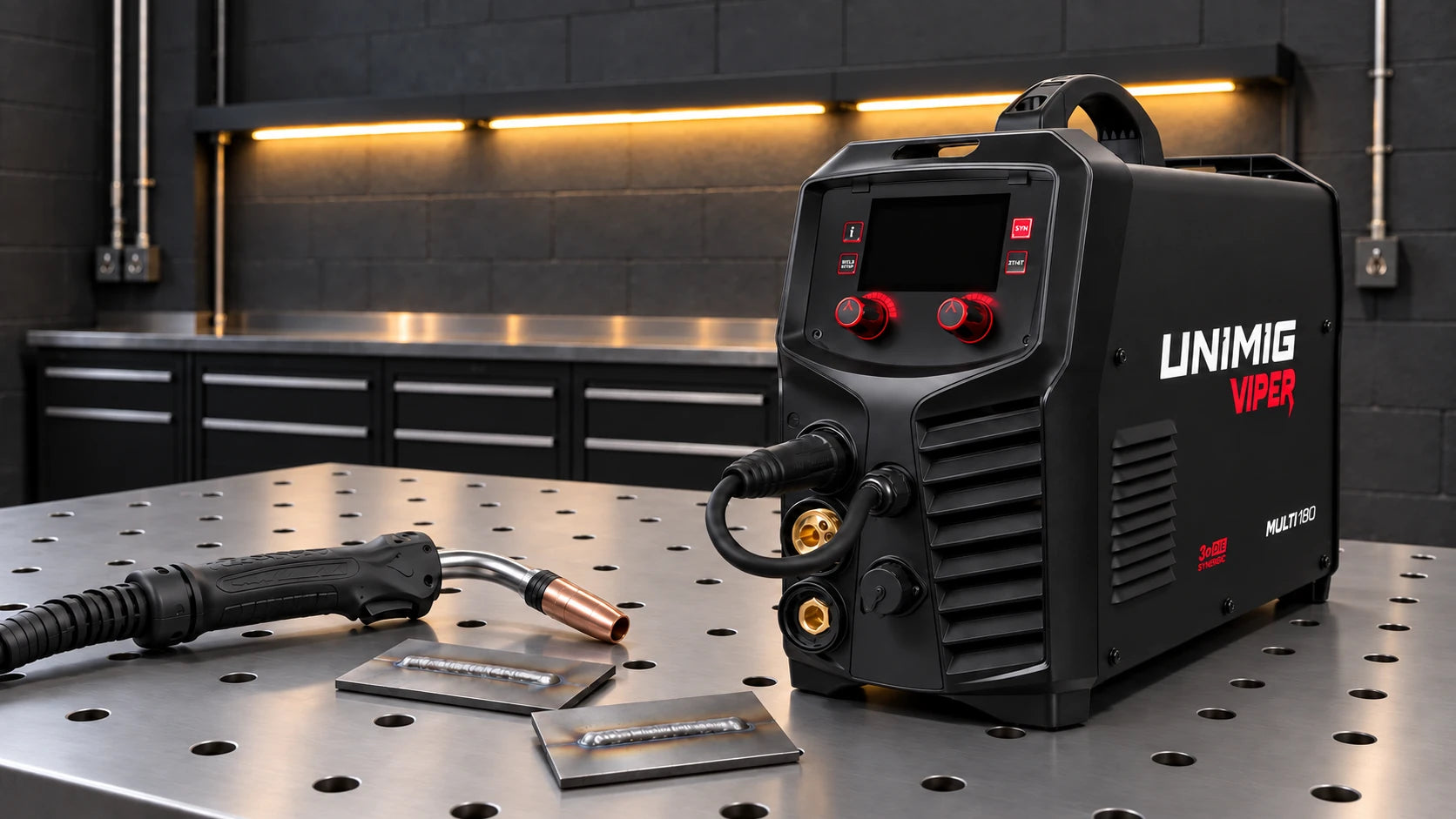
Looking for the best welder for your workshop? Maximum amps are only part of the decision. Welding duty cycle tells you how long a machine can work at a stated output before it needs to cool, which directly affects productivity, job flow and the type of welder you should buy.
This guide explains duty cycle and how to compare machines at the output your work requires. Product examples are a shortlist to investigate, not a guarantee of continuous production performance.
What is welding duty cycle?
Duty cycle is the percentage of a defined test period that a welder can operate at a specified output. A rating of 60% over 10 minutes means 6 minutes of welding followed by 4 minutes of cooling at that rated output.
The rating only makes sense when you read it alongside the output current, test period and conditions. A machine can have a higher duty cycle at a lower setting and a lower duty cycle near maximum output. Always compare the rating at the amperage you will actually use.
Why duty cycle matters when buying a welder
- Less downtime: the right capacity means fewer thermal cut-outs during repeated welds.
- Better production planning: operators can keep a predictable pace through a job.
- Longer equipment life: working within the manufacturer’s rating helps protect the machine.
- Smarter value: you pay for capacity that suits your work instead of chasing a headline amperage.
Which type of welder suits your work?
Duty cycle should be considered together with process, material, power supply and the length of your typical welds. These current A&S Welding Supplies products are useful starting points for different buying situations:
| Workshop need | Product to consider | Why it may fit |
|---|---|---|
| One compact machine for varied jobs | UNIMIG VIPER MULTI 180 MIG/TIG/MMA | A multi-process option when you want MIG, TIG and MMA capability in one machine. |
| General MIG and stick fabrication | RILAND 250GS 250A MIG/STICK | A higher-output MIG/STICK platform to compare for general fabrication and repair work. |
| TIG and stick work | IRONWELD SPARK 140 PULSE TIG/STICK | A compact TIG/STICK choice for workshops prioritising those processes. |
| Higher-throughput workshop welding | UNIMIG WORKSHOP 270 SWF | A workshop-class machine to investigate when duty cycle and sustained work are important. |
| Fast, low-distortion production work | IRONWELD 1500W Water-Cooled Laser Welder | A fibre laser platform to compare when speed, focused heat and reduced cleanup matter. |
Product suitability depends on your material, thickness, joint design, power supply and operator requirements. Use the table to shortlist machines, then check the individual specifications or speak with our team before ordering.
Duty cycle by welding process
MIG welding
MIG is often used for repeated fabrication welds, so duty cycle can make a visible difference to workflow. If you weld continuously on frames, brackets, trailers or general steelwork, compare the machine’s rating at your normal wire size and amperage.
Browse the MIG welder range for machines suited to different workshop sizes and output requirements.
TIG welding
TIG work may involve shorter welds and more repositioning, but longer stainless, aluminium or precision runs still create heat. Look at the rating at the current you need, along with AC/DC capability, pulse functions, cooling and torch comfort.
See the TIG welder range when clean, controlled welding is a priority.
MMA or stick welding
Stick welding naturally includes pauses for electrode changes and slag removal, but duty cycle still matters on heavier repairs and long runs. Compare portability, generator compatibility, output and thermal protection as well as the percentage rating.
Explore stick welders for portable repair and fabrication applications.
Multi-process welding
A multi-process welder can be a strong choice when one machine needs to cover MIG, TIG and MMA jobs. Compare duty cycle for each process rather than assuming the same rating applies across the board.
Review the multi-process welder range if flexibility is more valuable than a dedicated machine.
Fibre laser welding
Fibre laser systems also need to be assessed for sustained operation. Laser power, water cooling, travel speed, material thickness, shielding gas and setup all affect real-world output. A water-cooled laser welder may suit production environments, but it still needs the correct site, safety controls and trained operators.
For a laser system, request its operating limits at the intended power, ambient temperature and cooling conditions. Do not assume an arc-welder duty-cycle percentage transfers to a laser welder.
How to choose the right duty cycle for your workload
- Estimate your longest weld periods. Include repeated tacks, runs and production batches.
- Identify your normal output. Use the amperage or laser power you expect to run most often, not only the maximum.
- Allow for workshop conditions. Heat, dust, blocked vents and poor airflow can affect cooling.
- Check power and cooling. Confirm the plug, phase, circuit, water cooling and available floor space.
- Plan for growth. If production is increasing, some headroom can be more economical than replacing an undersized machine.
Common buying mistakes
- Choosing a welder by maximum amps alone.
- Comparing duty-cycle percentages without checking the rated output.
- Assuming a 100% rating means unlimited operation in every environment.
- Ignoring the duty-cycle difference between MIG, TIG, MMA and multi-process modes.
- Buying a production machine without checking site power, ventilation, safety or training needs.
Frequently asked questions
Is a higher duty cycle always better?
Not always. Higher capacity is valuable when you regularly weld for long periods, but a compact machine may be better value for short repairs or occasional work. Match the rating to your workload.
Can I weld past the rated duty cycle?
Follow the manufacturer’s instructions and allow the machine to cool when required. Repeatedly exceeding the rating can cause shutdowns, reduce service life and create unsafe operating conditions.
Should I buy MIG, TIG, multi-process or laser?
Choose the process for the material, joint, access and required weld quality first. Then compare output, duty cycle, accessories and installation requirements for the exact models on your shortlist.
Get help choosing the right welder
The best machine is the one that fits your materials, weld length, output, power supply and budget. Browse the welding machine range or contact A&S Welding Supplies with your typical job details. Our Smithfield team can help you compare the right process, capacity and accessories before you buy.
Related guides
Buying adviceBest Beginner Welder Australia 2026: MIG, TIG or Multi-Process? Buying adviceLaser Welders in Australia: How to Choose a Fibre Laser Welder Machine guideUNIMIG ENVY OMNI 220 AC/DC: Features and Workshop UsesFind a welder that fits your workload.
Tell us your process, working current and typical time spent welding.
Ask us about thisTechnical sources and scope
Reviewed 22 September 2026. Manufacturer examples apply to the named equipment; use the current manual for your exact model and the required welding procedure.
Product examples are a shortlist, not a verified production-capacity comparison. Obtain output-specific ratings for a purchase.


