
If you're new to welding in Australia, choosing the right machine can feel overwhelming. There are plenty of options, and picking the wrong one can mean frustration, extra cost, or welds that don't hold up on your first projects—whether that's in a garage, workshop, or on-site.
For general mild-steel projects, MIG is a practical process to learn first. A multi-process machine is useful if you will use its other modes, but check exactly what they include: many entry models offer DC lift TIG, not AC TIG for conventional aluminium work.
Here's a clear breakdown to help you decide what's best in 2026, based on what works for people starting out or moving into more regular use.
When a multi-process machine makes sense
List the materials and joints you expect to weld before comparing machines. Aluminium TIG and aluminium MIG require different capabilities and accessories.
- Versatility: MIG, TIG and stick can share one power source, but available modes, output and accessory requirements vary by model.
- Value: One machine and set of leads instead of separate units.
- Room to grow: You can learn and improve on the same equipment rather than outgrowing an entry-level single-process model too soon.
- Current features: Many now include pulse modes, synergic settings, and better arc control, which make it easier to get consistent results while you're still dialing things in.
The main trade-offs: It takes a bit longer to learn the different modes, and the upfront cost is higher than a basic MIG-only setup.
MIG vs TIG vs Stick: Quick Comparison for Beginners
| Process | Ease for Beginners | Best For | Thickness considerations | Portability | Gas Required? | Main learning task |
|---|---|---|---|---|---|---|
| MIG | Easiest | General fabrication, steel repairs, frames and fences | Output, joint preparation and transfer mode determine the range | High | External gas for MIG; self-shielded flux-cored wire is a separate process | Control torch position and wire-feed settings |
| TIG | Hardest | Clean welds on aluminium, stainless, or thin materials | Thin or thick work requires the appropriate output and procedure | Medium | Yes | Coordinate torch, filler and heat |
| Stick | Medium | Outdoor repairs and heavier steel, after proper cleaning | Thin sheet is demanding; no universal 2 mm minimum | Very High | No | Maintain arc length as the electrode shortens |
| Multi-Process | Medium (but builds skills fast) | Learning multiple processes in one machine | Varies | High | Varies by process | Learn each process and its setup separately |
- MIG: Automatic wire feed means you concentrate on steady movement and angle. Gasless flux-cored wire works well if you're on the move or prefer no bottles.
- TIG: Requires more control (torch and filler rod), but produces very clean results. Best to add this later unless your work is mostly thin or non-ferrous metals.
- Stick: A simple setup without an external shielding-gas cylinder can suit outdoor repairs. Clean the joint and use an electrode suited to the material, position and procedure.
Budget for the complete setup: machine, torch or holder, gas where required, consumables, PPE, extraction and a suitable electrical supply.
Recommendations from Our Multi-Function Range
Compare the current collection by process capability, rated output and supply requirements. Do not assume every multi-process model has the same TIG functions.
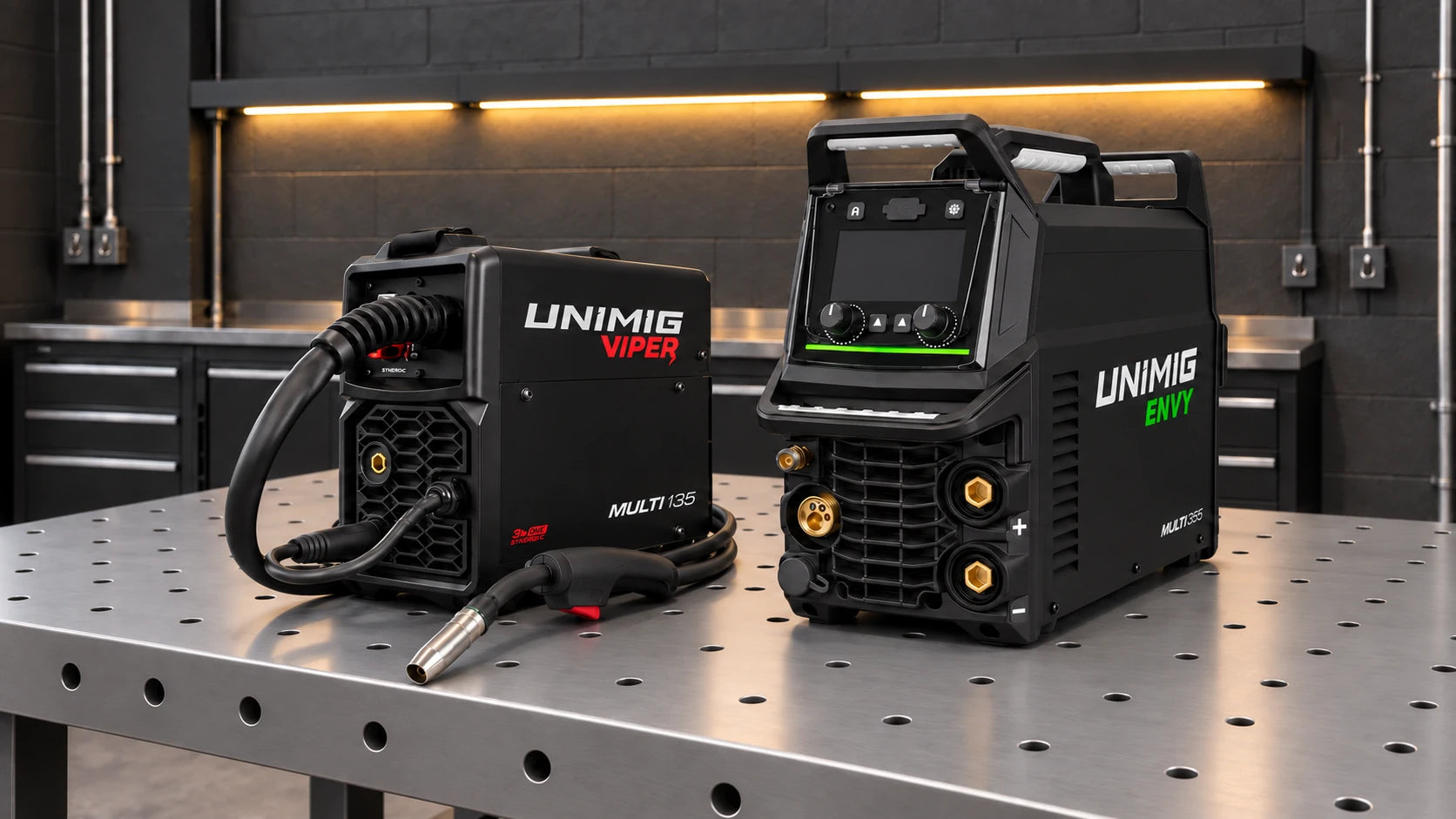
- Entry-level examples: The VIPER MULTI 135 and older VIPER MULTI 165 illustrate compact multi-process options. UNIMIG lists the MULTI 165 U11006K as discontinued; confirm the exact model, availability and included accessories.
- Workshop options: Compare current models against your required output and duty cycle. The RAZOR MULTI 175 U11007K is also listed as discontinued, so it should not be treated as a current-range recommendation.
- Higher-feature options: Compare the UNIMIG ENVY MULTI 195, ENVY MULTI 230 AC/DC and ENVY MULTI 250 AC/DC individually. The ENVY MULTI 195 has high-frequency DC TIG; it should not be grouped under a blanket full-AC/DC-TIG claim. Check each model’s process list, power supply and accessories.
Don't forget the essentials:
- An auto-darkening welding helmet for proper protection and visibility.
- Consumables matched to the chosen process, material and machine.
Tips Before Buying
- Check the model's voltage, phase, plug and circuit requirements. A household outlet is not automatically suitable for every welder.
- Compare duty cycle at your normal welding output and stated test conditions, as well as at maximum output.
- Pick up good leads, clamps, and PPE from the start—a solid setup makes a big difference.
- Request the model's compliance documentation and installation instructions; do not rely on a blanket claim about an entire range.
- Consider hands-on learning: TAFE courses or reliable online tutorials help a lot when starting out.
Choose the simplest machine that supports your actual work and planned learning. Extra modes are useful only when their capability, accessories and duty cycle suit the job.
Take a look at the multi-function welders here. We're based in Smithfield, family-run since 2002, with advice on hand, Australia-wide shipping, repairs, and hire options. Any questions? Get in touch—we're happy to help match the right machine to what you're doing. 💪
Sources for revised guidance
Related guides
Process guideWhat Is MIG Welding? Setup, Wire Feed and Technique Process guideWhat Is Stick (MMA) Welding? The Basics for Beginners Buying adviceChoosing a Welding Helmet: A Practical Buying ChecklistChoose for your first projects.
Tell us what you want to build, your power supply and your budget for the complete setup.
Ask us about thisTechnical sources and scope
Reviewed 22 September 2026. Manufacturer examples apply to the named equipment; use the current manual for your exact model and the required welding procedure.
- UNIMIG — ENVY MULTI 195 process specification
- UNIMIG — discontinued model support catalogue
- SafeWork NSW — Welding processes code of practice (2022)
Subjective scores, universal thickness bands, price tiers and blanket compliance assurances were removed. Legacy products are labelled.


